Enter Note
Authors: Presenting Author: Aravind Mittur, PhD – UCB Biosciences
Christopher Rubino, PharmD – Institute for Clinical Pharmacodynamics; James Wheless, BScPharm, MD – University of Tennessee Health Science Center, Le Bonheur Children’s Hospital; Brooks Boyd, PhD – UCB Biosciences
Poster Number: 1.474
Rationale:
Fenfluramine (FFA) has been approved for the treatment of Dravet syndrome (DS) and Lennox-Gastaut syndrome (LGS) in patients ≥ 2 years in the US and EU. Concomitant antiseizure medications (ASMs) and patient characteristics may influence exposure to FFA and its active metabolite norfenfluramine (nFFA). This analysis used population pharmacokinetic (PPK) modeling to describe steady-state systemic exposure to FFA and nFFA in LGS patients, quantify the potential impact of concomitant ASMs, and identify sources of variability and population characteristics to further inform dosages in the clinical setting.
Methods:
The PPK model developed using data from healthy volunteers and patients with DS was fit to PK data from participants in North America, Europe, and Australia from a double-blind, randomized phase 3 clinical trial in LGS. Participants 2 through 35 years of age randomized to placebo, 0.2 mg/kg/d FFA, or 0.7 mg/kg/d FFA (max: 26 mg/d) were titrated to their maintenance dose over two weeks. Participants remained on their assigned dose over a twelve week maintenance phase. Blood samples were collected in the maintenance phase for determination of FFA and nFFA concentrations in plasma. A total of 164 patients (0.2 mg/kg/d, n=84; 0.7 mg/kg/d, n=80) were included in the PK analysis; none received stiripentol. Post-hoc steady-state exposures (Cmin, Cmax, AUC0-24) to FFA and nFFA, interindividual variability, and the effects of potential covariates (concomitant ASMs [including phenobarbital, valproate, clobazam, and carbamazepine], age, sex, race, and creatinine clearance [CLcr]) on FFA and nFFA exposure were determined using the PPK model.
Results:
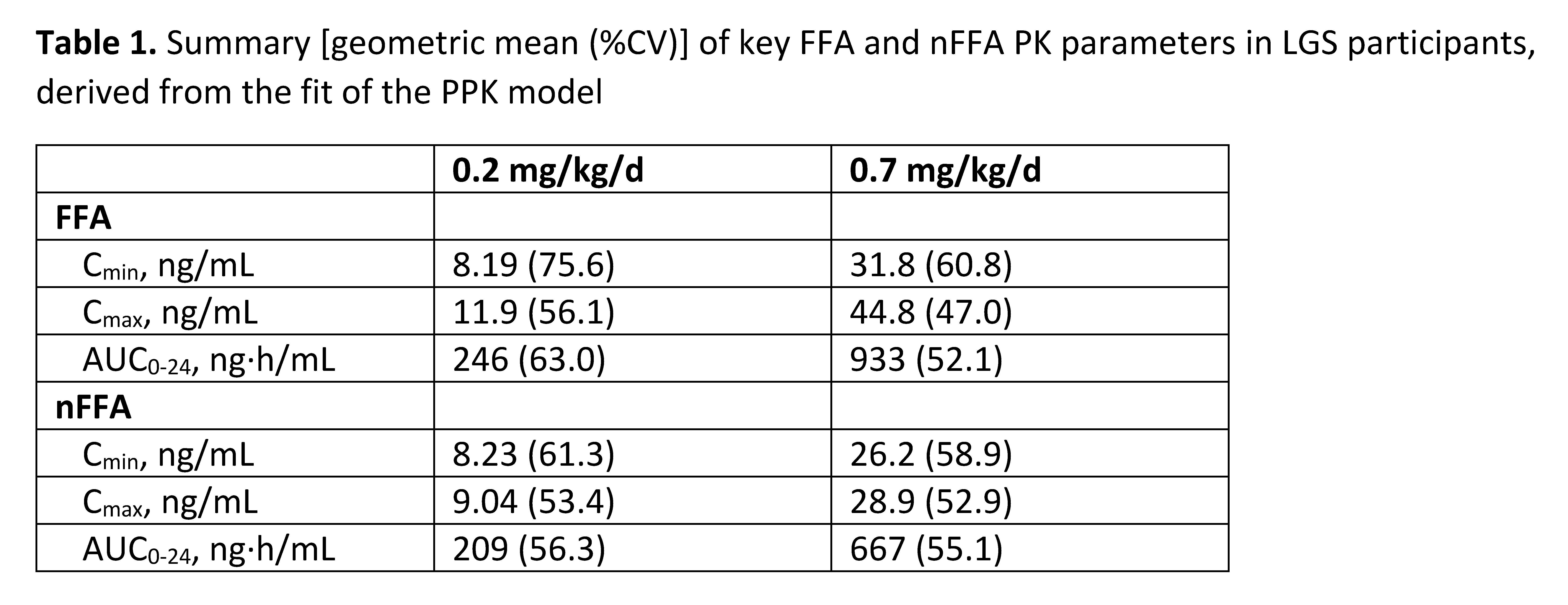
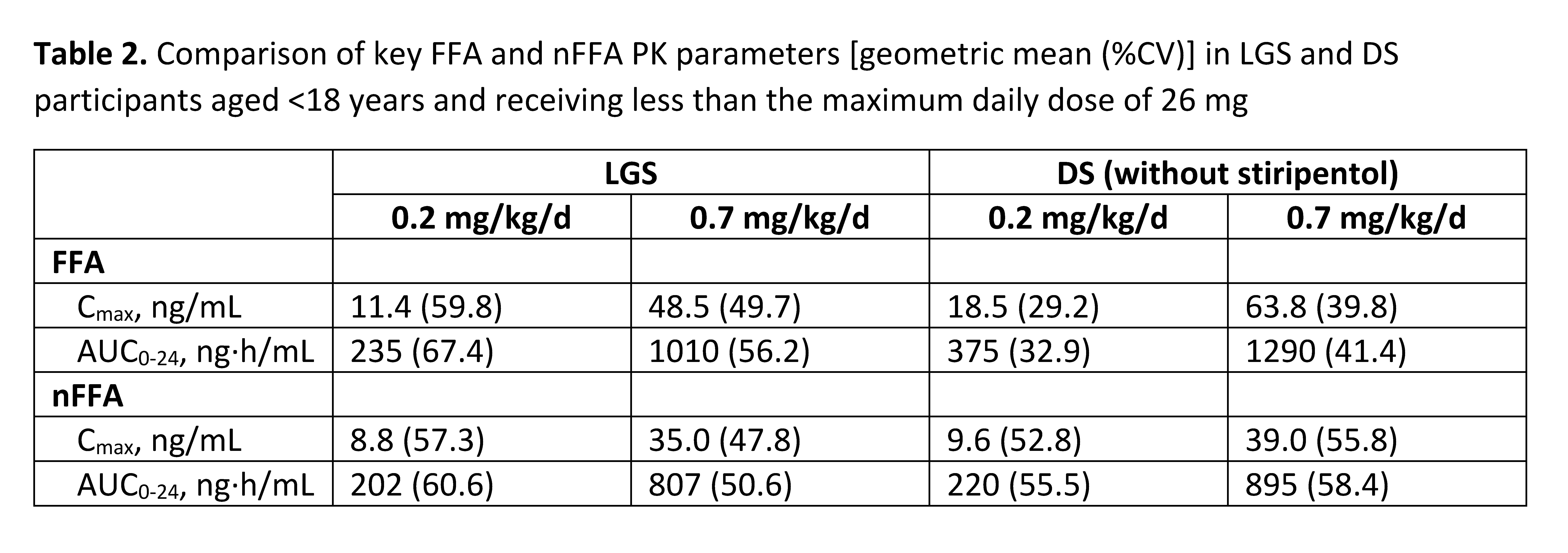
The structure of the DS PPK model was retained and consisted of two compartments with linear clearance for FFA and nFFA and adequately characterized FFA and nFFA PK profiles in LGS patients. After inclusion of body weight, the only covariate relationship of significance was between CLcr and nFFA PK; no other covariates were influential. Participants treated with 0.7 mg/kg/d had higher steady-state exposure values (Cmin, Cmax, AUC0-24) than those treated with 0.2 mg/kg/d (Table 1). FFA and nFFA exposures in LGS increased dose-proportionally in participants with body weight < 37.5 kg (i.e. below the max 26 mg/d). In participants treated with 0.7 mg/kg/d, the geometric mean for FFA CL/F was 20.9 L/h and Vss/F was 511 L; nFFA CL/F was 36.0 L/h and Vss/F was 768 L. FFA and nFFA exposures in LGS patients < 18 years of age are compared to DS patients without stiripentol in Table 2.
Conclusions:
Steady-state exposure to FFA and nFFA was characterized in pediatric and adult patients with LGS. The dose range of FFA and exposures to FFA and nFFA were within the characterized and effective range in phase 3 DS studies. Alternative dosing regimens are not required for subpopulations of LGS based on age, BMI, CLcr, sex, or race. Although study participants with LGS had lower systemic exposures compared to study participants with DS, the exposures overlapped significantly, and the differences are not clinically meaningful. Therefore, recommended doses are the same for LGS and DS patients.
Funding: Funded by UCB Pharma.
Christopher Rubino, PharmD – Institute for Clinical Pharmacodynamics; James Wheless, BScPharm, MD – University of Tennessee Health Science Center, Le Bonheur Children’s Hospital; Brooks Boyd, PhD – UCB Biosciences
Poster Number: 1.474
Rationale:
Fenfluramine (FFA) has been approved for the treatment of Dravet syndrome (DS) and Lennox-Gastaut syndrome (LGS) in patients ≥ 2 years in the US and EU. Concomitant antiseizure medications (ASMs) and patient characteristics may influence exposure to FFA and its active metabolite norfenfluramine (nFFA). This analysis used population pharmacokinetic (PPK) modeling to describe steady-state systemic exposure to FFA and nFFA in LGS patients, quantify the potential impact of concomitant ASMs, and identify sources of variability and population characteristics to further inform dosages in the clinical setting.
Methods:
The PPK model developed using data from healthy volunteers and patients with DS was fit to PK data from participants in North America, Europe, and Australia from a double-blind, randomized phase 3 clinical trial in LGS. Participants 2 through 35 years of age randomized to placebo, 0.2 mg/kg/d FFA, or 0.7 mg/kg/d FFA (max: 26 mg/d) were titrated to their maintenance dose over two weeks. Participants remained on their assigned dose over a twelve week maintenance phase. Blood samples were collected in the maintenance phase for determination of FFA and nFFA concentrations in plasma. A total of 164 patients (0.2 mg/kg/d, n=84; 0.7 mg/kg/d, n=80) were included in the PK analysis; none received stiripentol. Post-hoc steady-state exposures (Cmin, Cmax, AUC0-24) to FFA and nFFA, interindividual variability, and the effects of potential covariates (concomitant ASMs [including phenobarbital, valproate, clobazam, and carbamazepine], age, sex, race, and creatinine clearance [CLcr]) on FFA and nFFA exposure were determined using the PPK model.
Results:
The structure of the DS PPK model was retained and consisted of two compartments with linear clearance for FFA and nFFA and adequately characterized FFA and nFFA PK profiles in LGS patients. After inclusion of body weight, the only covariate relationship of significance was between CLcr and nFFA PK; no other covariates were influential. Participants treated with 0.7 mg/kg/d had higher steady-state exposure values (Cmin, Cmax, AUC0-24) than those treated with 0.2 mg/kg/d (Table 1). FFA and nFFA exposures in LGS increased dose-proportionally in participants with body weight < 37.5 kg (i.e. below the max 26 mg/d). In participants treated with 0.7 mg/kg/d, the geometric mean for FFA CL/F was 20.9 L/h and Vss/F was 511 L; nFFA CL/F was 36.0 L/h and Vss/F was 768 L. FFA and nFFA exposures in LGS patients < 18 years of age are compared to DS patients without stiripentol in Table 2.
Conclusions:
Steady-state exposure to FFA and nFFA was characterized in pediatric and adult patients with LGS. The dose range of FFA and exposures to FFA and nFFA were within the characterized and effective range in phase 3 DS studies. Alternative dosing regimens are not required for subpopulations of LGS based on age, BMI, CLcr, sex, or race. Although study participants with LGS had lower systemic exposures compared to study participants with DS, the exposures overlapped significantly, and the differences are not clinically meaningful. Therefore, recommended doses are the same for LGS and DS patients.
Funding: Funded by UCB Pharma.