Enter Note
Authors: Presenting Author: Srihari Jaganathan, MS – UCB, Inc.
Derek Ems, MPH, CPHQ – UCB, Inc.; Rob Sederman, MBA – Ambit Inc.; Chen Chen, MA – Ambit Inc.; Shuang Wu, PhD – Ambit Inc.
Poster Number: 3.49
Rationale: Dravet syndrome (DS) is a rare early-onset epilepsy syndrome, characterized by a life-long form of developmental and epileptic encephalopathy (DEE) that typically begins in infancy and is marked by frequent, treatment-resistant seizures, significant developmental, motor, and behavioral impairments, and an increased risk of mortality and sudden unexpected death in epilepsy (SUDEP). Following FDA approval of the fenfluramine oral solution in June 2020 for epilepsy treatment in DS, our objective was to understand the medication persistence associated with the use of fenfluramine and compare it with valproate, a very commonly used medication among individuals with DS, and levetiracetam.
Methods: We analyzed patient-level US claims data to measure the 12-month persistence of fenfluramine, valproate, and levetiracetam following initial treatment. Individuals with prior/concomitant use of cannabidiol or stiripentol were excluded (fenfluramine use was also excluded for valproate and levetiracetam analysis). Individuals with DS were identified by International Classification of Diseases (ICD-10) diagnosis codes. Persistence was defined as the duration of continuous medication supply without a gap of more than 90 days. Kaplan-Meier survival analysis was used as an estimate and log-rank tests were used to compare persistence rates between the three treatment groups, with p < 0.05 as the threshold for significance. Censoring occurred at the end of the follow-up period.
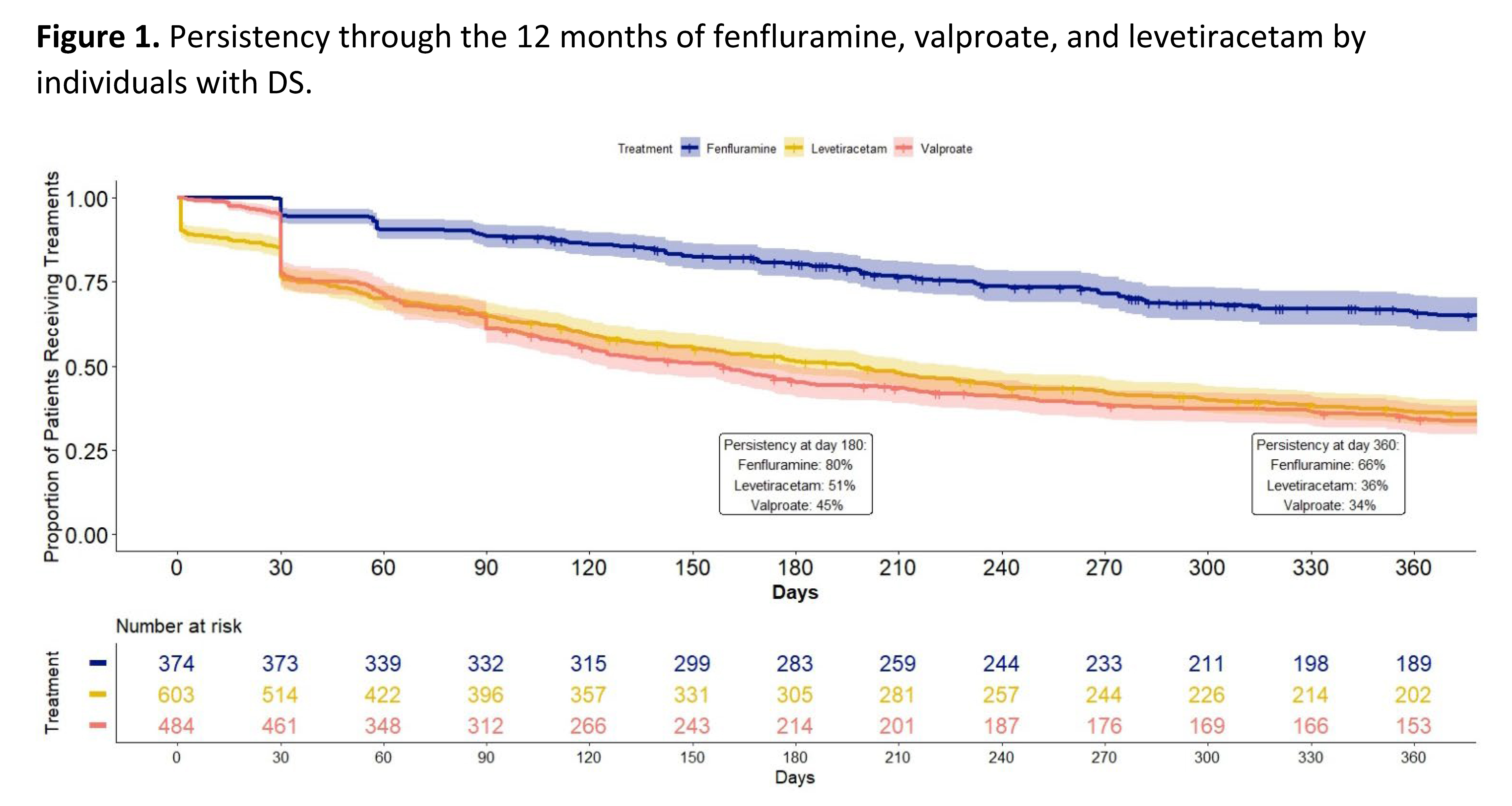
Results: We identified 374 individuals with DS who used fenfluramine, 484 who used valproate, and 603 who used levetiracetam, all of whom had met study criteria. The overall six month persistence rate for fenfluramine was 80%, for valproate was 45%, and for levetiracetam was 51%. For 12-month persistence rate, fenfluramine was 66%, valproate was 34%, and levetiracetam was 36% (Figure 1). Individuals who initiated fenfluramine were more likely to be persistent compared with individuals who initiated valproate (p < 0.001, Figure 1), and those who initiated levetiracetam (p < 0.001, Figure 1).
Conclusions: We found that fenfluramine demonstrates a stronger persistency compared to valproate, an earlier treatment for individuals with DS, and levetiracetam. Strong persistency is typically associated with improved efficacy and tolerability for chronic medications, suggesting real-world benefits of fenfluramine use in this population.
Funding: Funded by UCB, Inc.
Derek Ems, MPH, CPHQ – UCB, Inc.; Rob Sederman, MBA – Ambit Inc.; Chen Chen, MA – Ambit Inc.; Shuang Wu, PhD – Ambit Inc.
Poster Number: 3.49
Rationale: Dravet syndrome (DS) is a rare early-onset epilepsy syndrome, characterized by a life-long form of developmental and epileptic encephalopathy (DEE) that typically begins in infancy and is marked by frequent, treatment-resistant seizures, significant developmental, motor, and behavioral impairments, and an increased risk of mortality and sudden unexpected death in epilepsy (SUDEP). Following FDA approval of the fenfluramine oral solution in June 2020 for epilepsy treatment in DS, our objective was to understand the medication persistence associated with the use of fenfluramine and compare it with valproate, a very commonly used medication among individuals with DS, and levetiracetam.
Methods: We analyzed patient-level US claims data to measure the 12-month persistence of fenfluramine, valproate, and levetiracetam following initial treatment. Individuals with prior/concomitant use of cannabidiol or stiripentol were excluded (fenfluramine use was also excluded for valproate and levetiracetam analysis). Individuals with DS were identified by International Classification of Diseases (ICD-10) diagnosis codes. Persistence was defined as the duration of continuous medication supply without a gap of more than 90 days. Kaplan-Meier survival analysis was used as an estimate and log-rank tests were used to compare persistence rates between the three treatment groups, with p < 0.05 as the threshold for significance. Censoring occurred at the end of the follow-up period.
Results: We identified 374 individuals with DS who used fenfluramine, 484 who used valproate, and 603 who used levetiracetam, all of whom had met study criteria. The overall six month persistence rate for fenfluramine was 80%, for valproate was 45%, and for levetiracetam was 51%. For 12-month persistence rate, fenfluramine was 66%, valproate was 34%, and levetiracetam was 36% (Figure 1). Individuals who initiated fenfluramine were more likely to be persistent compared with individuals who initiated valproate (p < 0.001, Figure 1), and those who initiated levetiracetam (p < 0.001, Figure 1).
Conclusions: We found that fenfluramine demonstrates a stronger persistency compared to valproate, an earlier treatment for individuals with DS, and levetiracetam. Strong persistency is typically associated with improved efficacy and tolerability for chronic medications, suggesting real-world benefits of fenfluramine use in this population.
Funding: Funded by UCB, Inc.