-

- Comparative Risk of New-Onset Seizure Among Smoking Cessation Pharmacotherapies
-
Poster Number: 2.128
Rationale: Despite recent declining prevalence, cigarette smoking remains the leading cause of preventable death in the United States.1 Pharmacologic interventions for smoking cessation are effective and recommended by the United States Preventive Services Task Force (USPSTF) for non-pregnant adult tobacco users.2 However, certain approved pharmacotherapies have been implicated in lowering seizure threshold.3 We aimed to investigate the association between smoking cessation therapy (SCT) use and self-reported seizures.
Methods: This is a retrospective IRB-approved project. We identified 5,174 records of seizure-free adults who were later started on SCT by the ACT Center for Tobacco Treatment, Education, and Research between 2007 and 2019. Subsequent incidence of seizure reporting was analyzed by Cox survival analysis. Hazard ratio was calculated for comparison of seizure incidence based on the type of SCT. A p-value of < 0.05 was considered significant.
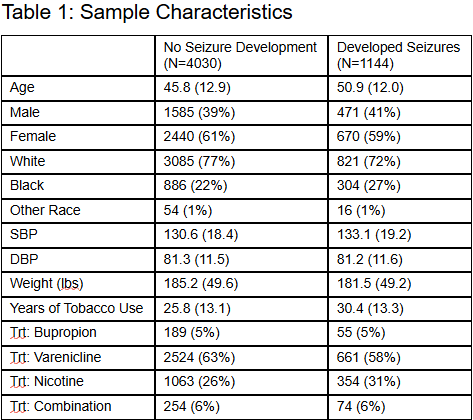
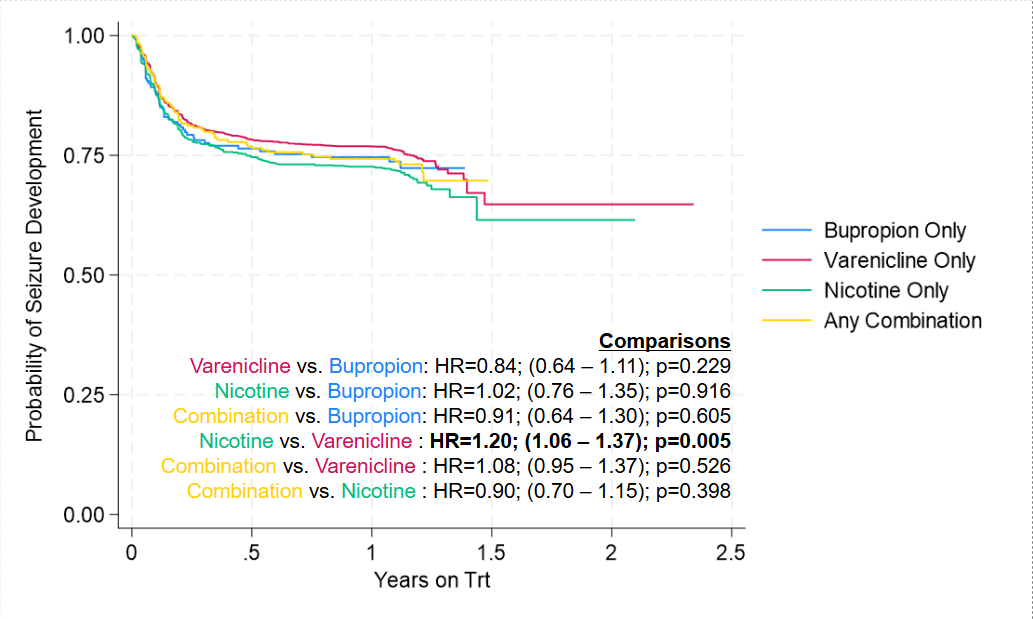
Results: Nicotine replacement therapy (NRT) (1,417; 27%), varenicline (3,153; 62%), bupropion sustained-release (244; 5%), or combination therapy (328; 6%) were used. Overall incidence of reported new-onset seizures was 1,144; 22%. Seizures were reported in 354 patients on NRT, 661 on varenicline, 55 on bupropion, and 74 on combination therapy. NRT resulted in 1.20 (95% CI, 1.06-1.37) times greater risk of developing new-onset seizure than varenicline treatment. No other significant differences between the treatment groups were detected.
Conclusions:This study demonstrates that overall incidence of new-onset seizures is high in tobacco smokers started on SCT. When comparing treatment groups, increased risk of new-onset seizure was identified only with NRT relative to varenicline. Although smoking cessation has significant health benefits, patients on SCT require close monitoring for seizure occurrence.
Funding:This research received no external funding.
References
1. U.S. Department of Health and Human Services. The Health Consequences of Smoking—50 Years of Progress: A Report of the Surgeon General. Atlanta: U.S. Department of Health and Human Services, Centers for Disease Control and Prevention, National Center for Chronic Disease Prevention and Health Promotion, Office on Smoking and Health, 2014.
2. Patnode CD, Henderson JT, Coppola EL, et al. Interventions for tobacco cessation in adults, including pregnant persons: updated evidence report and systematic review for the US Preventive Services Task Force. JAMA. 2021;325(3):280-298.
3. Selby P, Zawertailo L. Tobacco Addiction. New England Journal of Medicine. 2022 Jul 28;387(4):345–54.
 Types
Enter Note
Go to previous page in this tab
Session
