-

- Development of Novel Clinical Global Impression Scales Specific to the Common Signs and Symptoms of GRIN-Related Neurodevelopment Disorder
-
Poster Number: 3.266
Rationale:
GRIN-related neurodevelopmental disorder (GRIN-NDD) is a rare developmental and epileptic encephalopathy that stems from pathogenic variants of GRIN genes that encode N-methyl-D-aspartate (NMDA) receptor subunits. GRIN-NDD manifests as clusters of related neurologic symptoms that can include early-onset seizures, intellectual disability, developmental delays, hypotonia, autism spectrum disorders, behavioral symptoms, and movement disorders. There are currently no established fit-for-purpose GRIN-NDD clinical assessments for evaluating symptom severity and treatment effects. GRIN-specific Clinical Global Impression severity (GRIN-CGI-S) and change (GRIN-CGI-C) scales are being developed based on a conceptual model derived from qualitative research of caregivers of children with GRIN-NDD.
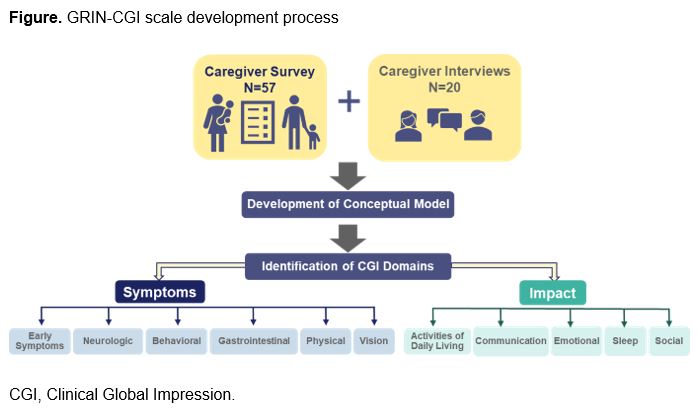
Methods:Adult caregivers (age ≥ 18 years) of patients (age ≤ 18 years) with a clinical diagnosis of GRIN-NDD stemming from GRIN1, GRIN2A, GRIN2B, or GRIN2D gene variants were recruited through patient advocacy groups to complete an online survey. Survey results were used to develop a qualitative interview guide. A subset of caregivers participated in 90-minute interviews. A conceptual model was developed based on survey results and refined after interview analysis to identify important signs and symptoms of GRIN-NDD to be included in novel CGI-S and CGI-C scales measuring severity and change in GRIN-NDD symptoms.
Results: Fifty-seven caregivers of 58 children with GRIN-NDD participated in the survey; 20 survey respondents participated in interviews. Caregivers reported a range of neurologic, behavioral, and physical symptoms, including gastrointestinal and vision symptoms, that were included in the conceptual model (Figure). Aggregated data were used to identify the domains of receptive and expressive communication; gross and fine motor function; and behavioral regulation as important treatment targets representing the focus of measurement domains in the GRIN-CGI scales. Severity on the GRIN-CGI-S is rated as 1=Normal, no impairment to 7=Extreme and pervasive impairment. Change on each GRIN-CGI-S domain will be scored from 1=Much improved to 7=Much worse. The GRIN-CGI-C will include specific examples of skills/symptoms in each domain as well as suggested prompting questions for clinicians to discuss with caregivers. The GRIN-CGI scales have been refined and qualitatively validated by concept elicitation and cognitive debriefing through interviews with therapeutic area experts. Psychometric validation is ongoing. The GRIN-CGI scales are included as efficacy assessments in a Phase 3 radiprodil clinical trial (Beeline) to measure the severity and change across the spectrum of GRIN-NDD symptoms.
Conclusions:The development and validation of GRIN-CGI-S and GRIN-CGI-C scales will facilitate assessment of the efficacy of radiprodil across GRIN-NDD symptom domains identified by caregivers as being important to treat.
Funding:Funding support was provided by GRIN Therapeutics, Inc., a Neurvati Neurosciences Company.
 Types
Types
Enter Note
Go to previous page in this tab
Session





.jpeg.jpg)