-

- Final Results From a Long-Term Open-Label Extension Study (Up to 4 Years): Tolerability of Fenfluramine and Global Functioning of Pediatric and Adult Patients With Dravet or Lennox-Gastaut Syndromes
-
Poster Number: 2.428
Rationale: Dravet syndrome (DS) and Lennox-Gastaut syndrome (LGS) are rare developmental and epileptic encephalopathies characterized by drug-resistant seizures and developmental delay. Fenfluramine (FFA) is approved for treatment of seizures in DS and LGS in many regions based on its safety and efficacy established in 4 randomized controlled trials and 2 open-label extension (OLE) studies. Here we report the final results from a combined OLE study evaluating the long-term safety of FFA and global functioning in pediatric and adult patients (pts) with DS or LGS treated with FFA through May 22, 2025.
Methods: This international, multicenter OLE study (NCT03936777) enrolled pts who had participated in a prior FFA open-label study (NCT02823145 [DS], NCT03355209 [LGS], or NCT03467113 [DS/LGS, FFA+concomitant cannabidiol]) and received ≥1 concomitant anti-seizure medication. Last FFA doses from the prior studies were continued, then flexibly titrated as needed (max FFA 0.7 mg/kg/d [26 mg/d] without stiripentol [STP] or FFA 0.4 mg/kg/d [17 mg/d] with STP). The primary objective was to assess long-term FFA safety and tolerability. Secondary objectives included evaluation of pt global functioning via Clinical Global Impression–Improvement (CGI–I) ratings by caregiver and investigator at last visit vs this OLE study baseline. Post hoc analyses were conducted by age group (pediatric: 2–17y; adult: ≥18y) and to calculate overall FFA exposure. Descriptive statistics were used.
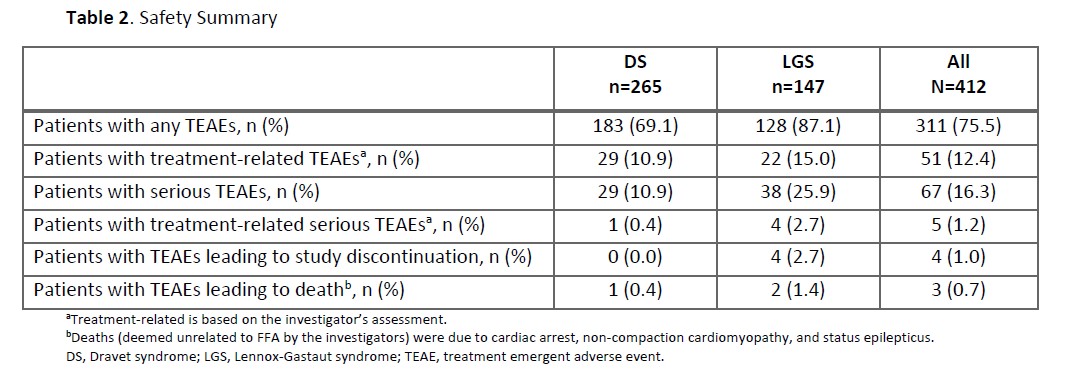
Results: A total of 412 pts were enrolled (DS: 265 [64.3%], LGS: 147 [35.7%]). Mean (SD) age was 14.1y (6.8), 69.2% were aged 2–17y and 30.8% were aged ≥18y; 72/265 (27.2%) and 55/147 (37.4%) pts with DS and LGS, respectively, were adults. Across all pts in this OLE study, median FFA treatment duration was 729.5d (range, 8–1544; Table 1). Although the discontinuation rate in pts with LGS (29.9%) was greater vs that in pts with DS (3.0%), the FFA exposure was higher in pts with LGS vs DS. Overall median FFA exposure across all studies was 1464.5d (range, 171–2800). At least 1 treatment emergent adverse event (TEAE) was reported in 311 (75.5%) pts and FFA-related (per investigator) serious TEAEs were reported in 5 (1.2%) pts; 3 pts died (deemed unrelated to FFA by the investigators; Table 2). TEAEs or serious TEAEs rates were lower in pts with DS vs LGS. No cases of clinically confirmed valvular heart disease or pulmonary arterial hypertension were reported. On last visit CGI–I, 251/258 (97.3%) pts with DS were rated by both caregivers and investigators as “improved/no change” vs this OLE study baseline; of 143 pts with LGS, 122 (85.3%) and 125 (87.4%) pts received an “improved/no change” CGI–I rating, respectively, by caregivers and investigators vs this OLE study baseline.
Conclusions: In this OLE study of patients with DS or LGS, TEAEs were consistent with the known FFA safety profile, and no new or unexpected safety signals were observed. Investigator and caregiver CGI–I ratings suggested sustained clinical benefit (median overall FFA exposure = 4 years). These data support long-term FFA use in pediatric and adult patients with DS or LGS.
Funding: UCB.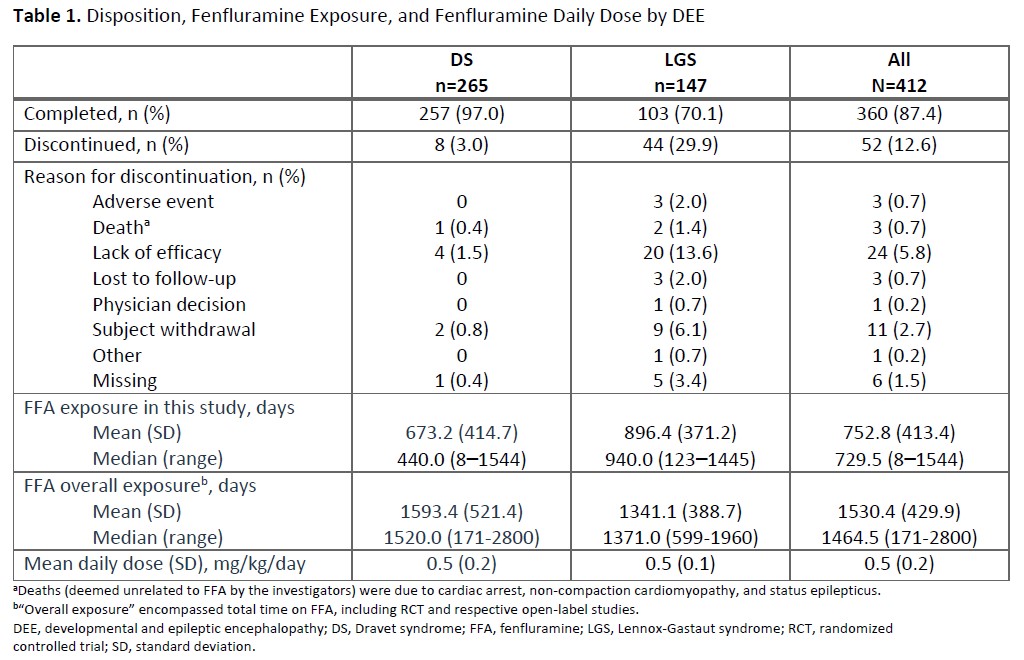
 Types
Types
Enter Note
Go to previous page in this tab
Session
.jpg)